The Emu War of 1932
In 1932, Australian troops were outmaneuvered and outwitted by large, flightless birds.
About The War
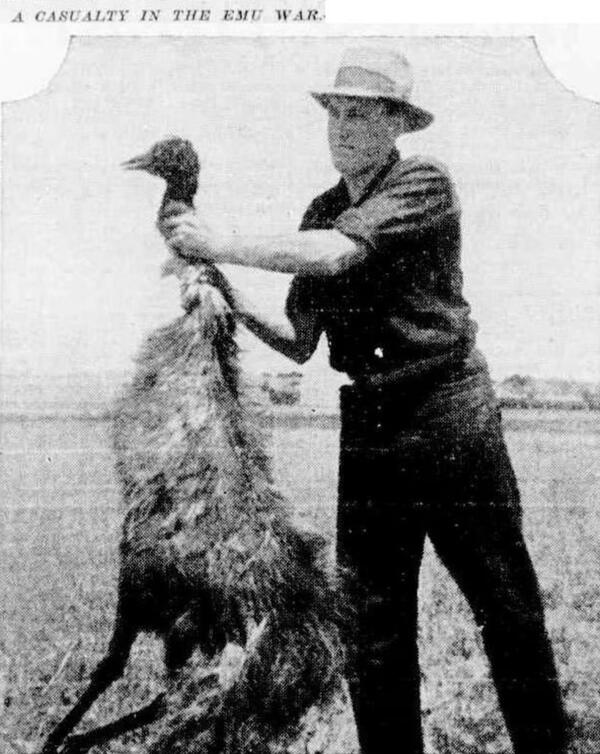
After World War I, many returned Australian servicemen were given land by the government in the Wheatbelt region of Western Australia.
Then in early 1930s wheat prices plummeted, due to the Great Depression. Thus, farmers expanded their crops as they desperately needed profit.
During this period, their crops weren't the only ones growing in size, 20,000 migrating emus found their way onto farms after breeding, in the process destroying fences and valuable crops.
Desperate for support, local farmers called for help from then-Defence Minister Sir George Pearce, who sent the army over to help.
In charge was Major GPW Meredith, alongside him were Sergeant McMurray and Gunner O’Halloran. Together these three men armed with machine guns stood against a wave of 20,000 emus.
At least, this is what they thought would happen. In reality, the emus travelled in small groups of 10 to 50 emus. As such, the group had to set up small
On the 2nd of November, the war began. On the first day, 20 emus were killed. The second, 12. On the 3rd, close to none.
Over the three days, constant gunfire had scared off the birds. Not only that, but the emus were also extremely hardy, Major Meredith referred to them as "having the invulnerability of tanks".
The troops, knowing they were fighting a losing battle, credited the enemies with unusual terms such as quoting that the emus "Had developed guerilla tactics" and had "picked pack leaders to stand watch, aiding in their escape". The war ended in 6 days on the 8th of November after the troops called a tactical withdrawal.
In the years that followed, farmers requested aid multiple times only to be denied.
The Crisis
The Emu War was a crisis because West Australia farmers were having problems with how expensive equipment was compared to other states. As such, their fences were not very strong, making them prone to being destroyed by emus. WA kept asking for help from the government and federal government kept on denying their request. Due to this, the Wheat Growers Union pushed for secession, the government, realising they needed WA, quickly rushed to aid in whatever issue WA had. In this case, was with the emus (McManus, 2022)
The Response
The response was bad because it did not solve the issue of the emu's destroying fences and crops and the mission to wipe out the emus failed miserably. This also impacted the Australian governent as they became a bit of a laughing stock for other countries. Emus continued to be a major problem in subsequent decades, despite an expansion of the state barrier fence and an emu bounty system set up by the state government. (McManus, 2022)
The Present
Currently, emus are contained through a bounty system. Despite the problems encountered in the war, the farmers of the region once again requested military assistance in 1934, 1943, and 1948, only to be turned down by the government. Instead, the bounty system that had been instigated in 1923 was continued, and this proved to be effective: 57,034 bounties were claimed over a six-month period in 1934. Fences have been strengthened to prevent themselves from being destroyed by emu attacks.
Bibliography
- Jayden Jeow